


That's not a couple talking.
That's a room full of EFT therapists, mid-discussion on last Friday's monthly call, voicing what an affair couple is silently thinking the moment a clinician tries to go straight for the feelings. "There's no way," one of them said, stepping into the client's shoes. "You do not have access to my vulnerable heart."
It's a good line because it's true. And it points straight at the question every affair-recovery clinician eventually has to answer: how do you get access to something a person has every reason to keep locked down?
EFT and the Gottman Method both take that question seriously. They just answer it differently, and we examined those differences in our July call.
Gottman tends to build a key first. Assessment sessions, a shared verification protocol, concrete markers for what commitment and safety actually look like day to day. It gives a couple — and a clinician — something to hold onto when everything feels like it's dissolving.
EFT tends to ask you to leave the door unlocked and see who's brave enough to walk through it. Slower, less concrete, and considerably scarier for a couple who just found out the worst thing they feared was true.
Neither one is wrong. One clinician on the call put it about as honestly as I've heard it said: "I'm always EFT minded, but sometimes it's those Gottman tools" that she reaches for early on. She wasn't talking in the abstract. She had a couple in the room — wife eager, leaning in, practically finishing the clinician's sentences; husband arms crossed, deadpan, clearly not there yet. The second she reached for anything EFT-flavored with him, his face told her to back up. So she'd hand him something concrete instead — a Speaker-Listener exercise, a map of the Sound Relationship House — something with edges he could actually hold.
It's an incredibly common shape for a couple to take. And here's the trap, half-joking but not really: Gottman's tools are a little like the stereotypical drug dealer. First, a little sample to see if it rings any bells. Frequently it works, the couple feels a flicker of relief, and suddenly you're reaching for another tool, and another, because it's working — right up until you notice you've built an entire treatment plan out of homework and haven't gotten anywhere near the longing underneath it.
Another clinician pushed the thought even further. Both models, he said, can get dogmatic when you follow them too literally — prescriptive in a way that starts working against the couple instead of for them. Early on, he tried running intake exactly as written: together, then separately, then back together, because the model "knows best." What he learned was that their structure isn't always the right structure. So he built his own — two joint sessions up front, then individual sessions for each partner. Nine times out of ten he does two apiece, before circling back together. Longer than either textbook version. Closer to what the couple in front of him actually needed.
It's very much a "your milage may vary" thing. Most of us aren't running either model exactly as written. We're triaging. Reaching for Gottman's scaffolding when someone needs something to hold onto, reaching for EFT's depth when someone's ready to be found. The couple in front of you doesn't know which theoretical camp they've wandered into, and they shouldn't have to.
We did highlight a quieter thing both models agree on: underneath the anger, the surveillance, the phone checks and the silence, most people aren't asking to be punished or forgiven. They're asking if it's safe to want their partner again. The models frame it differently. Gottman might call it rebuilding trust. EFT might call it accessing the longing behind the emotion. Different vocabulary, same door.
That was the heart of this month's free Ohio EFT call — walking EFT and Gottman side by side through affair recovery specifically, where they genuinely diverge, and where most of us, apparently, land somewhere in between. Next month we're setting the comparison aside entirely. Kaira Gramley and Carolyn Wenner are leading a session on "attachifying" — the specific language we reach for in session to keep pulling a couple back toward each other, since attachment sits underneath all of it anyway. Well worth clearing an hour for.
Now, on with this week's Ohio EFT Newsletter:
Are Therapists To Blame For The Rise Of Adults Cutting Off Their Parents?
by Elizabeth Bernstein on August 3rd, 2026
Many moms and dads believe that their adult children are getting bad advice—and a growing number of researchers agree. ‘Everything becomes trauma.’
If You Want To Keep Your Relationship Strong, Do More Of This.
by Jenna Ryu on August 3rd, 2026
Curiosity might be the key ingredient for a healthy partnership. Here’s the easiest way to keep it alive.
‘Our Spark Has Gone’: The Marriages Ruined By Ozempic.
by Melissa Twigg on August 3rd, 2026
As weight-loss jabs flatten libido and trigger sudden personality shifts, long-term relationships reach a breaking point.
Four Major Relationship Hurdles That Can Happen After Retirement.
by Jenna Ryu on August 3rd, 2026
Retirement can shift a relationship’s dynamics in ways you may not anticipate. Here’s how experts suggest overcoming these hurdles.
The Next Ohio EFT Virtual Call Is Friday, August 28th.
by Ohio EFT on August 3rd, 2026
Join us at 9:00am on Friday, August 28th as we continue our discussion series about Emotionally Focused Therapy.
This month we'll be discussing "attachifying" - ways that EFT therapists use language to highlight the bond between a couple, deepen emotion and add relational context.
We'll have the link to the call in the next edition of the newsletter.
Hope you can make it!
How to Start ‘The Talk’ With Aging Parents.
by Clare Ansberry on August 3rd, 2026
Most families avoid detailed conversations about aging, housing and care, even though they’re crucial.
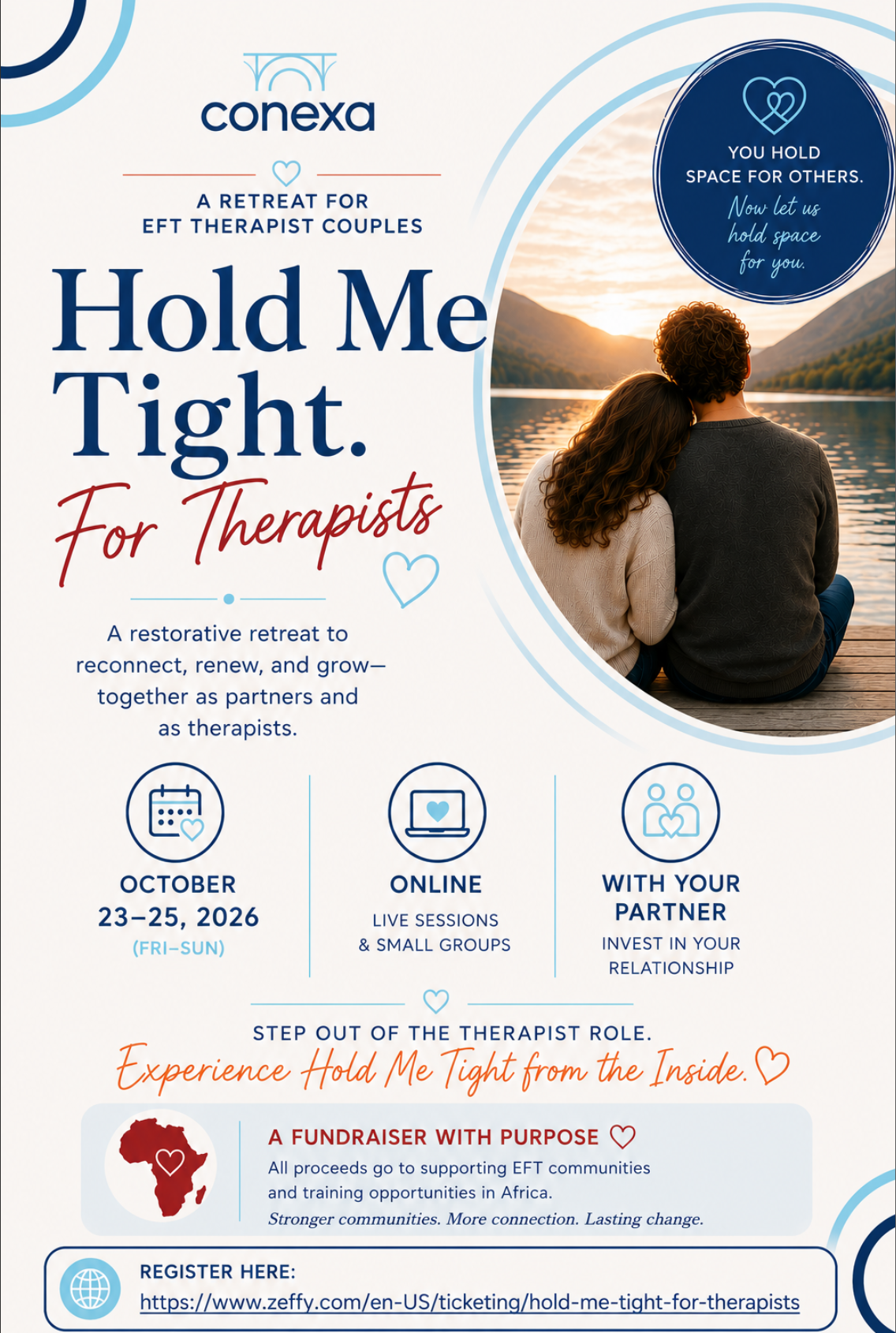
Learning EFT From The Inside: A Hold Me Tight Online Retreat For Midwest Therapists & Their Partners.
by Pendo Galukande on August 3rd, 2026
I am a Ugandan Couple and Family Therapist currently pursuing a doctorate at Michigan State University.
Learning Emotionally Focused couple Therapy (EFCT) has been transformational for me. This is why I urgently needed for the training to come to Uganda. In 2023, through CONEXA International, an organization headed by Dr. Mark Maxwell an EFT therapist from California, a team of American, South African and Canadian therapists came to Uganda bringing the first ever EFT externship to East Africa. They made what seemed like a distant dream come true! Since then, the work has been ongoing in Uganda, Kenya, Zimbabwe and Ethiopia and CONEXA has become a very special part of my personal and professional journey. I am grateful to now be helping organize a fundraising initiative for the work.
The Current Project
EFT therapists from the West Coast will be facilitating an online Hold Me Tight Retreat for East Coast and Mid West Therapists and Their Partners. The online workshop will take place on October 23–25, 2026. The Price is $700 per couple (Early bird registration, $600, and ends 31st August 2026). The vision behind this retreat is Learning EFT from the Inside; creating a space where therapists can experience the power of the work they so often facilitate for others. As a fundraising initiative, the proceeds from the online retreat will support the continued development of EFT communities and training opportunities in East Africa, where Conexa has partnered with local leaders to help establish EFT Externships, Core Skills programs and supervision communities.
8 Books to Help You Navigate Divorce.
by Anna Borges on August 3rd, 2026
Whether you’re contemplating a split, or in the process of one, these books can help.
4 Prompts That Can Tell You What Chatbots Really Know About You.
by Brian X. Chen on August 3rd, 2026
It can be unsettling what Gemini and ChatGPT have figured out about you and how easily your privacy can be punctured. Here’s how to find out.


